A nail shape finder is a practical decision method that matches your manicure silhouette to your natural nail anatomy, hand proportions, and daily routine.
Picking a shape purely from inspiration photos often leads to chipped corners, awkward proportions, or nails that snag before the week is over.
When you understand how your cuticle line, nail bed width, and nail strength interact with different silhouettes, choosing a shape becomes straightforward—whether you file your nails at home or sit in a salon chair.
Find Your Perfect Nail Shape 💅
Discover the nail shape that complements your natural nails and personal style.
Your Perfect Nail Shape Is…
♡ Other shapes you might love
Your result is a style recommendation based on your answers, not a definitive assessment. Nail shape is also influenced by nail health, personal preference, and maintenance needs.
Quick Answer: A nail shape finder matches your manicure silhouette to four core factors: your cuticle curve, nail bed width, finger length, and daily routine. Mirroring your natural cuticle line creates visual harmony, while aligning tip shape with nail strength minimizes breakage, such as choosing squoval for active hands or almond for longer nails.
What Is a Nail Shape Finder and How Does It Work?
A nail shape finder evaluates how a nail’s tip silhouette balances your hand’s natural proportions while staying durable enough for your daily habits. Rather than treating nail shapes as one-size-fits-all trends, this approach treats shape selection as a blend of visual symmetry and basic nail structure.
Before choosing a silhouette, it helps to know five simple nail-anatomy terms you will see throughout this guide:
- Nail bed: The pink skin underneath your nail plate where the nail stays attached to your finger.
- Cuticle line: The base where your nail emerges from the skin at the bottom of the nail plate (often called the proximal nail fold in dermatology).
- Free edge: The white or unattached tip of the nail that extends past your fingertip and gets filed into shape.
- Sidewalls: The straight vertical outer edges running down the left and right sides of your nail.
- Stress point: The spot on each sidewall where the attached nail bed ends and the free edge begins—this is where most breaks start.
Every nail shape changes how much weight and pressure rests on your free edge and stress points.
A silhouette that flatters your hand visually will only stay neat if your natural nail plate—or an enhancement like gel or acrylic—can physically support it.
The 4-Step Nail Shape Finder Method
Find Your Perfect
Nail Shape
Not sure which nail shape suits you best? Follow these four simple steps to discover your perfect match.
Your 4-Step Method
01 — 04Look at Your Finger Shape
Observe your finger length and width. Long, slender fingers can complement many shapes, while shorter fingers may benefit from elongating styles.
Examine Your Natural Nail Bed
Check your nail’s natural width and curve. Wide nail beds often suit oval or round shapes, while narrower beds can work beautifully with almond styles.
Consider Your Everyday Lifestyle
Think about work, hobbies, and daily activities. Short, rounded nails are practical, while longer shapes may need extra care and maintenance.
Choose Your Ideal Nail Shape
Compare round, square, oval, almond, and coffin styles. Pick the one that balances your comfort, personal taste, and desired look.
You can determine your ideal nail shape in under two minutes by checking four traits on your own hands in order: cuticle curve, nail bed width, finger length, and lifestyle demands.
Hold your hand out in good light, palm facing down, and work through the checklist below.
Step 1: Check Your Cuticle Line Shape
The easiest visual rule in nail shaping is to mirror the natural curve of your cuticle line at the free edge.
When the top and bottom of your nail share a similar curve, the nail looks intentional and balanced without requiring dramatic length.
- Rounded or U-shaped cuticles: Naturally harmonize with round, oval, or almond tips.
- Flat or boxy cuticles: Pair cleanly with square or squoval tips.
- Slightly tapered or pointed cuticles: Complement oval, almond, or softly tapered coffin silhouettes.
If your fingers have slightly different cuticle curves—which is completely normal—base your choice on your middle and ring fingers, as they draw the most visual attention.
Step 2: Assess Your Nail Bed Width and Length
Your nail bed determines how much visual “canvas” you have before the free edge even begins.
Shapes with softer or tapered sides create the illusion of slenderness, while flat, horizontal tips emphasize width.
- Wide nail beds: Benefit from gently curved or tapered shapes like squoval, oval, or almond, which draw the eye toward the center rather than the outer edges.
- Narrow nail beds: Hold crisp, flat-edged shapes like square and squoval effortlessly because straight sidewalls add balanced structure.
- Short nail beds: Look longer with round, oval, or squoval silhouettes that keep the visual line flowing smoothly past the fingertip.
- Long nail beds: Can wear virtually any shape—including sharp square or dramatic tapered tips—without looking crowded or stubby.
Step 3: Look at Finger Length and Hand Proportions
Just like clothing necklines affect how tall or broad someone looks, nail shapes subtly shift how long your fingers appear.
Horizontal lines stop the eye, while curved or tapered tips extend it.
- Short or wider fingers: Typically look most elongated with oval, almond, or softly rounded silhouettes that extend slightly past the fingertip.
- Long, slender fingers: Look balanced in square, squoval, or coffin shapes, which introduce clean horizontal lines without making fingers look overly narrow.
- Prominent knuckles: Often look softer when paired with curved silhouettes (round, oval, or squoval) rather than sharp geometric corners.
Step 4: Match Your Shape to Nail Strength and Daily Routine
Even the most flattering shape becomes frustrating if it chips every time you open a clasp or type an email.
Always let your daily hand use and nail thickness act as the tiebreaker.
- Heavy typing, frequent handwashing, or hands-on work: Choose short round or squoval shapes with no sharp corners to catch on surfaces.
- Thin, flexible, or peeling natural nails: Stick to short round or soft squoval shapes so the free edge stays close to the fingertip and resists bending.
- Strong natural nails or structured enhancements: Can safely support medium-to-long oval, almond, coffin, or stiletto silhouettes.
Complete Guide to Core Nail Shapes (Comparison Table)
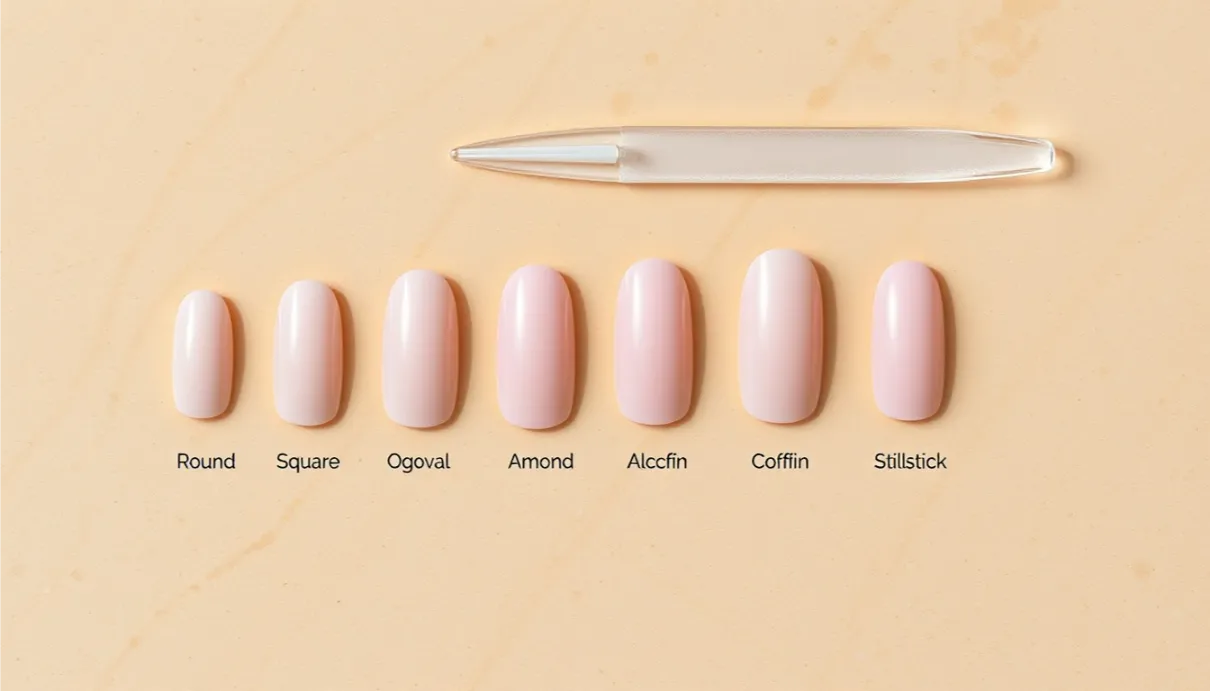
The eight classic nail shapes differ primarily in two ways: how sharply the sidewalls taper inward and whether the free edge finishes in a flat line, curve, or point.
Use the table below to compare how each shape looks, behaves, and holds up in everyday wear.
| Nail Shape | Tip Silhouette | Best Length | Most Flattering For | Durability on Natural Nails | Best Suit (Natural vs. Enhancement) |
| Round | Soft semicircle mirroring fingertip | Short | Wide nail beds, short fingers, brittle nails | High (few snag points) | Ideal for natural nails |
| Square | Straight sidewalls, flat tip, crisp 90° corners | Short to medium | Narrow nail beds, long slender fingers | Moderate (corners can chip or catch) | Good for strong natural nails or gel |
| Squoval | Straight sidewalls, flat tip, softly rounded corners | Short to medium | Almost all hand types and nail beds | Very high (balanced support, no sharp corners) | Ideal for natural nails and gel |
| Oval | Gently tapered sidewalls, smooth egg-shaped tip | Short-medium to long | Short fingers, wide or short nail beds | High (no sharp corners to snag) | Great for natural nails with modest free edge |
| Almond | Noticeably tapered sidewalls, narrow rounded point | Medium to long | Short or wider fingers, wide nail beds | Moderate on bare nails; high with gel/acrylic | Best with strong nails or builder gel/extensions |
| Coffin / Ballerina | Dramatically tapered sidewalls, flat squared-off tip | Medium-long to extra long | Long or average fingers wanting bold style | Low on bare nails (sidewalls heavily tapered) | Best with acrylic, hard gel, or full-cover tips |
| Stiletto | Steeply tapered sidewalls meeting at a sharp point | Long to extra long | Hands wanting maximum visual elongation | Very low on bare nails | Requires acrylic, hard gel, or structured extensions |
| Lipstick | Straight sidewalls, diagonally slanted flat tip | Medium to long | Narrow to average nail beds seeking editorial look | Low to moderate (angled point snags easily) | Best with structured gel or acrylic |
Everyday Natural Shapes: Round, Square, and Squoval
Round, square, and squoval are the most beginner-friendly shapes because they preserve full sidewall width and work well at short lengths.
- Round: Filed straight along the sides and curved smoothly around the fingertip. Because there are no corners sticking out, round nails rarely catch on knitwear, keyboards, or pockets, making them the safest starting point for recovering or fragile nails.
- Square: Features straight parallel sidewalls and a flat top edge with crisp 90-degree corners. Square nails showcase clean, modern lines—especially with French tips—but those sharp corners take the brunt of everyday bumps and tend to chip first on flexible natural nails.
- Squoval: A hybrid of square and oval that keeps the clean, flat center of a square nail while softly rounding the outer corners. If you are unsure where to start, squoval is widely considered the easiest universal shape because it flatters almost every nail bed while minimizing corner breaks.
Elongating Shapes: Oval and Almond
Oval and almond nails are the top choices for making hands look longer and more slender, though beginners frequently confuse the two.
- Oval: Keeps straighter sidewalls near the nail bed and rounds smoothly into a symmetrical curve at the tip. Because the sides do not narrow sharply, oval works on shorter free edges and maintains solid structural strength on natural nails.
- Almond: Tapers inward along the sidewalls starting closer to the stress point, narrowing into a slim, softly rounded peak that resembles a raw almond. That narrower taper creates stronger finger elongation than oval, but it requires enough free edge—typically at least a quarter of an inch past the fingertip, depending on nail bed width—to look proportionate without weakening the sides.
Statement and Enhancement Shapes: Coffin, Stiletto, and Lipstick
Coffin (also called ballerina), stiletto, and lipstick shapes prioritize bold geometry and usually require salon-grade structural support rather than bare natural nails.
- Coffin / Ballerina: Narrows sharply along both sides like an almond, then finishes with a crisp, flat horizontal tip. Removing that much material along the outer edges makes thin natural nails prone to side cracks, so most wearers pair coffin shapes with builder gel, dip powder, acrylic, or soft-gel tips.
- Stiletto: Tapers steeply from the stress point to a fine point. While it offers the most dramatic lengthening effect, the delicate point offers minimal impact resistance and is best suited for structured enhancements and low-impact routines.
- Lipstick: Features straight sidewalls with a tip filed at a sharp diagonal angle resembling a fresh tube of lipstick. It is an editorial, trend-driven shape that works best on medium-to-long enhancements because the elevated corner catches easily during everyday tasks.
How to Match Nail Shapes to Specific Hand Types and Lifestyles
Choosing a nail shape becomes much easier when you start with your specific hand features or daily constraints rather than trying to force a trend to fit.
Below are the most dependable matches for common beginner scenarios.
Best Nail Shapes for Short or Bitten Nails
Round and short squoval are the most practical shapes for short or recovering nails because they require almost no free edge to look polished. Trying to taper very short nails into almond or coffin shapes forces you to file too deeply into the sidewalls, which creates a triangular look and leads to painful side splits as the nail grows out.
As your nail bed recovers and your free edge extends a few millimeters past the fingertip, you can gradually transition from round to soft oval without sacrificing strength.
Best Nail Shapes for Wide Nail Beds or Shorter Fingers
Oval, squoval, and medium almond shapes create the strongest slimming and lengthening effect for wide nail beds or shorter fingers.
Soft curves and inward tapers pull visual focus along the center vertical line of the finger instead of accentuating width at the tip.
Conversely, very short, sharp square nails cut the finger off visually with a stark horizontal line, which can make shorter fingers look slightly broader—though a slightly longer squoval balances that effect nicely.
Best Nail Shapes for Long, Slender Fingers
Long, slender fingers provide the most flexibility and look especially balanced in square, squoval, and medium coffin shapes.
Because flat horizontal tips add visual weight across the fingertip, they complement naturally elongated proportions without making fingers appear overly narrow.
If you prefer curved shapes on long fingers, keeping an oval or almond tip at a short-to-medium length maintains clean proportions without looking exaggerated.
Best Nail Shapes for Typing, Active Hands, and Workplace Policies
Short round and squoval nails outperform every other silhouette for people who type all day, lift weights, cook frequently, play stringed instruments, or wear disposable gloves.
Keeping the free edge close to the fingertip prevents the nail from striking keys or jamming backward during physical tasks.
A note for healthcare, laboratory, and food-service professionals: Workplace dress codes, infection-control standards, and glove or PPE policies vary significantly by employer and jurisdiction.
Health authorities such as the Centers for Disease Control and Prevention (CDC) generally advise healthcare personnel providing direct patient care to keep natural nails short (commonly cited as less than 1/4 inch) and avoid artificial enhancements [VERIFY exact current CDC wording/measurement]. Always follow your facility’s official infection-control and PPE guidelines first.
Natural Nails vs. Enhancements: How Structure Affects Your Shape Choice
Your nail shape should never fight the structural limits of what your nail is made of.
Bare natural nails are flexible sheets of keratin (a fibrous structural protein), whereas enhancements like builder gel, hard gel, dip powder, and acrylic add rigid reinforcement.
One key concept nail technicians rely on is the apex—the subtle, highest point of the arch built over the nail’s stress area to absorb impact. On a long almond, coffin, or stiletto enhancement, a properly placed apex channels pressure away from the fragile stress points so the nail does not snap in half when bumped.
Bare natural nails have only their natural curve (called the C-curve) for support.
When you file a bare natural nail into a steep taper—like stiletto or sharp coffin—you remove the outer sidewalls that act like load-bearing beams. If you prefer wearing bare natural nails or regular lacquer, sticking to shapes that preserve fuller sidewalls (round, squoval, square, or gentle oval) dramatically cuts down on breaks and peeling.
Common Nail Shaping Mistakes and Myths vs. Facts
Most uneven shapes and premature breaks happen during filing, not because someone chose the “wrong” hand type.
Avoiding a few widespread habits immediately improves how clean and durable your shape looks.
Four Filing Mistakes to Avoid
- Sawing back and forth aggressively: Dragging a file rapidly back and forth across the free edge shreds the delicate keratin layers, which encourages peeling and splitting. Instead, use smooth, gentle strokes moving from the outer edge toward the center tip.
- Filing deeply into the sidewalls: Narrowing your nail by carving into the sides near the skin weakens the stress point and often triggers deep horizontal tears below the fingertip. Keep the file angled softly along the free edge, leaving the lower sidewalls straight and intact.
- Using an overly coarse grit on natural nails: Nail files are graded by grit number—the lower the number, the rougher the surface. Coarse 80- or 100-grit files are designed for thick acrylic enhancements, not natural keratin; for natural nails, cosmetology educators generally recommend a finer grit around 180 to 240 or a fine crystal glass file
[VERIFY standard cosmetology grit range]. - Judging symmetry from only one angle: Looking exclusively at your nails with your palm facing down can hide lopsided tips. Flip your hand around and inspect the tips facing toward you, just as other people see them, before finishing.
Nail Shape Myths vs. Facts
- Myth: Square nails are the strongest shape for natural nails.Fact: While square nails retain full sidewall width, their crisp 90-degree corners concentrate impact and snag easily on everyday objects. Softening those corners into a squoval or round shape typically makes natural nails last longer without chipping.
- Myth: Soaking nails in water before filing keeps them from splitting.Fact: Water temporarily swells the nail plate, making keratin softer and more prone to fraying or tearing when filed. Dermatologists and nail educators generally advise filing clean, completely dry nails for the cleanest edge.
- Myth: Almond nails only work on extra-long acrylic extensions.Fact: Almond nails do need moderate free-edge length to taper smoothly, but they do not have to be extreme. Medium-length natural nails—especially with a thin overlay of builder gel for reinforcement—can comfortably wear a soft almond silhouette.
- Myth: Every nail must measure the exact same millimeter length from the cuticle to look uniform.Fact: Natural nail beds vary slightly from finger to finger; your thumb and index nail beds are often different lengths than your ring or pinky fingers. Matching the visual length past the fingertip and keeping the tip silhouette consistent creates a much more uniform manicure than obsessing over identical ruler measurements.
When to See a Professional and Nail Safety Basics
This nail shape finder guide applies to healthy natural nails and routine cosmetic shaping at home or in a salon.
Knowing when to ask a licensed nail technician for help—and when to consult a medical professional—keeps cosmetic shaping safe.
When to Visit a Licensed Nail Technician
Consider working with a licensed professional if you are transitioning to a dramatically different silhouette (such as square to almond), want tapered shapes like coffin or stiletto that require structured gel or acrylic reinforcement, or struggle with uneven nails that curl downward or grow crookedly.
A skilled technician can build a balanced apex and file symmetrically without thinning your sidewalls.
When to Consult a Doctor or Dermatologist
Nail shaping is purely cosmetic and should never be used to mask underlying health symptoms.
Skip salon enhancements and speak with a board-certified dermatologist or qualified healthcare provider if you notice any of the following warning signs:
- Persistent swelling, redness, throbbing pain, or pus around the cuticle or sidewalls
- Nails lifting away from the nail bed (onycholysis)
- New dark vertical streaks, widespread yellowing, green discoloration, or thickening of the nail plate
- Severe, sudden brittleness or pitting that does not improve with gentle nail care
For routine home care, sanitize metal clippers regularly, replace worn emery boards that cannot be disinfected, and avoid sharing personal nail files to reduce the risk of transferring fungal or bacterial infections.
Frequently Asked Questions
What is the most universally flattering nail shape?
Squoval is the most universally flattering nail shape because it blends straight, structured sidewalls with gently rounded corners.
It complements both wide and narrow nail beds, works seamlessly on short-to-medium natural nails, and resists the corner chips and fabric snags that commonly affect sharp square nails.
What is the difference between oval and almond nails?
Oval nails keep fuller sidewalls and curve smoothly into a rounded, symmetrical tip, making them sturdy enough for shorter natural nails. Almond nails taper noticeably inward along the sidewalls into a slimmer, softly pointed peak, which elongates fingers more dramatically but requires extra length and strength.
Which nail shape is least likely to break on natural nails?
Round and short squoval shapes are the least likely to break on bare natural nails.
Because both follow the natural curve of the fingertip and remove sharp protruding corners, everyday bumps distribute more evenly across the free edge instead of catching and tearing at the stress points.
Should all ten nails be filed to the exact same shape?
Yes, keeping one consistent silhouette across all ten fingers creates the cleanest, most cohesive manicure.
However, minor natural variations are normal—if one nail breaks shorter than the rest, keeping the same tip style (for example, slightly shorter squoval) looks far more intentional than mixing unrelated shapes.
Can you get almond or coffin nails on short natural nails?
True almond and coffin shapes rarely work on very short natural nails because both require enough free edge past the fingertip to taper inward cleanly.
Filing a sharp taper into a short nail cuts too deeply into the sidewalls, weakening the nail; short oval or squoval is a safer interim choice while growing length.
Bringing Your Nail Shape Choice Together
Using a nail shape finder removes the guesswork from manicure planning by grounding your choice in anatomy and everyday practicality rather than fleeting trends.
Once you align your tip silhouette with how your nails naturally grow and how you use your hands, your manicures will look sharper and hold up significantly longer.