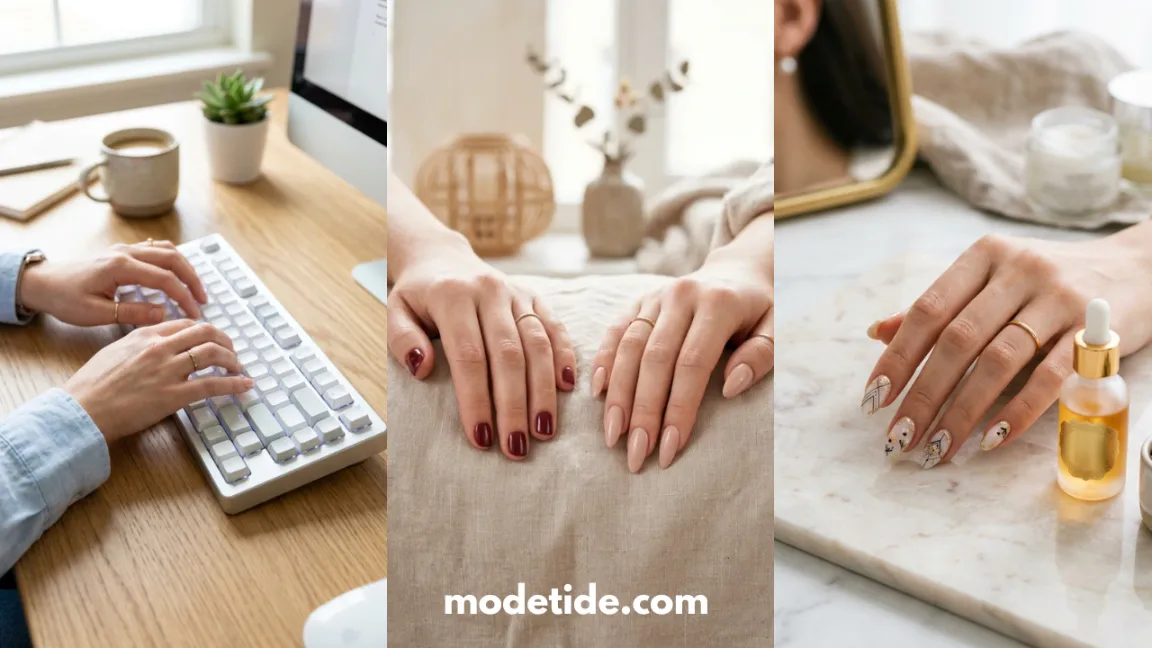
Staring at your hands wondering whether to clip your nails back or keep growing them out is a classic manicure standoff.
Maybe you love the dramatic look of long coffin nails on your Pinterest feed, but you also need to type 80 words per minute for work without popping off a tip.
The choice between short vs long nails ultimately comes down to your everyday habits, job demands, and how much time you want to spend on maintenance.
Here is a clear, criterion-by-criterion breakdown comparing both lengths so you can choose the right style for your lifestyle today.
Jump to Section
Quick Verdict Strip
Overall Winner
Short Nails
for most everyday routines
Best Low-Maintenance
Short Nails
under 5 min upkeep/week
Best for Statement Style
Long Nails
more nail art surface
But the ranking above only tells you half the story — the reason why matters more than the label. Here’s the full breakdown, criteria by criteria.
Short Nails vs Long Nails: At a Glance
| Criteria | Short Nails | Long Nails |
|---|---|---|
| Maintenance Time | ~5 min/week | 15–20 min/week |
| Breakage Risk | Low | Moderate–High |
| Typing / Daily Tasks | Easy | Takes adjustment |
| Nail Art Space | Limited | Wide open |
| Monthly Cost | $0–$15 | $25–$60 |
| Nail Health Impact | Minimal strain | More stress on nail bed |

What Counts as Short Nails?
Short nails means the white tip extends no more than 1–2 millimeters past your fingertip — sometimes not at all.
This includes classic “squoval” and round shapes, and it’s the length most workplaces and hands-on jobs consider standard.
If you can see your fingertip clearly past the nail, you’re in short territory.
What Counts as Long Nails?
Long nails start once the tip extends past the fingertip by a visible amount, usually 5mm or more, and can go all the way to extreme stiletto or coffin lengths using acrylic or gel extensions.
The longer the length, the more the nail relies on added product rather than your natural nail for strength — which is exactly why it changes everything about upkeep.
{RELATED LINK 1: Chrome Nails for Beginners}
If you’re keeping it short, chrome finishes make a plain manicure pop without any extra length.
{RELATED LINK 2: Chrome vs Cat Eye Nails}
Deciding on length is only step one — here’s how to pick a finish next.
Maintenance & Upkeep Time
Five minutes with a nail file once a week is basically all short, natural nails ask of you.
Long nails — especially anything built up with acrylic or gel extensions — need infills every 2–3 weeks to stop the base from lifting, plus regular buffing so small chips don’t spread into cracks.
Short nails win this one outright. There’s simply less surface and less structure to maintain, so a weekly trim and a cuticle push covers it.
Durability & Breakage Risk
Slam a car door, grab a heavy bag, catch a sleeve on a doorknob — short nails shrug most of that off.
Long nails don’t get the same luck, because more length past the fingertip means more leverage for a snag to turn into a full break.
Head-to-Head: The Same Snag, Two Different Outcomes
Short nail catches on a sweater sleeve: barely noticeable, maybe a tiny chip at the edge. Long nail catches the same way: often cracks right at the stress point near the nail bed — which can genuinely hurt and takes weeks to grow out.
Short nails win here too. Less length means less leverage, and less leverage means fewer painful breaks.
Keep Reading: Related Nail Guides
Everyday Practicality

Try buttoning a shirt, picking up a dropped coin, or typing a fast email with quarter-inch tips getting in the way.
Long nails turn small, automatic tasks into something you have to think about — and most people report needing about 2 weeks to adjust their grip and typing habits after a fresh set.
Jobs involving food, healthcare, or heavy keyboard use often require short nails outright for exactly this reason.
Short nails are the clear winner for daily practicality. The one place long nails pull ahead, though, has nothing to do with practicality — it’s the sheer amount of nail art real estate they open up.
Nail Art & Styling Versatility
A single long nail gives you room for a full mini scene — ombré fade, hand-painted florals, chrome tips, and rhinestone placement without anything looking cramped.
Short nails can absolutely wear nail art, but detailed designs get compressed into a tiny space, and anything with multiple layers (like 3D charms) tends to snag or fall off within days.
Long nails win this one clearly. More surface area means more room for the design to actually breathe, which is exactly why so many elaborate Pinterest nail looks are shot on longer sets.
Cost Over Time
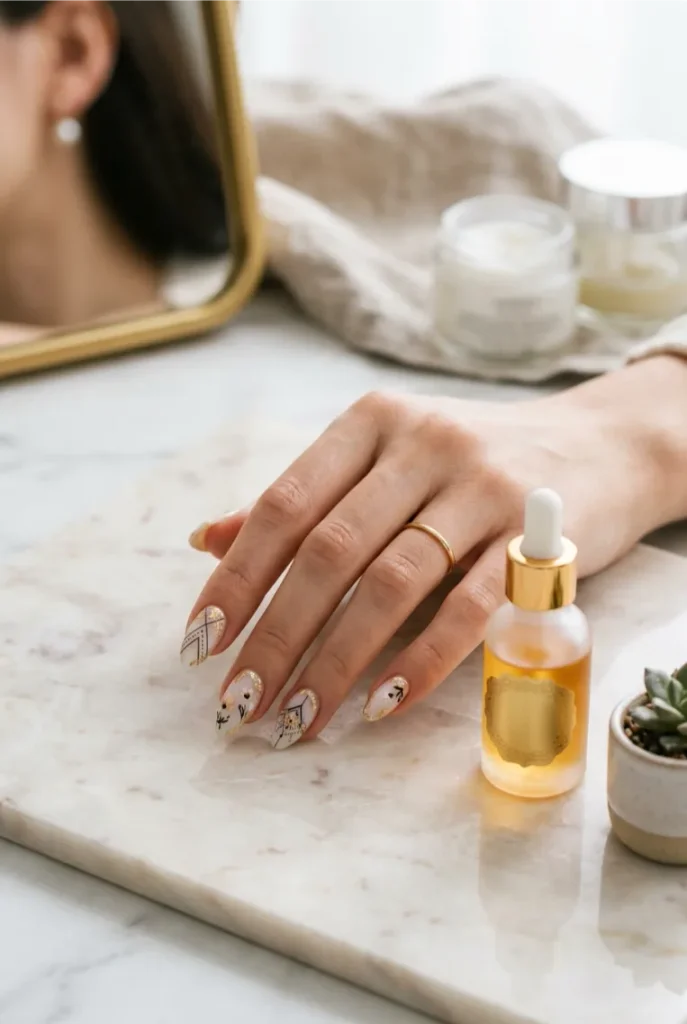
At-home short nails run roughly $0–15 a month — a bottle of polish and an occasional file replacement. Long nails, if you’re getting acrylic or gel-X extensions filled professionally, typically cost $25–60 every 2–3 weeks, on top of an initial full-set price of $50–80.
Add it up over a year and short nails land around $60–180, while maintained long extensions run $400–900 or more.
Short nails win decisively on cost — there’s no version of long, salon-maintained nails that comes close to competing here, even at the cheapest local salons.
Growth & Nail Health
This one isn’t as one-sided as it looks. Short, natural nails carry the lowest risk overall — nothing to soak off, nothing lifting at the base, minimal chance of the fungus or thinning that can happen when acrylic isn’t removed properly.
But short nails aren’t automatically “healthier” just by being short: aggressive filing or picking at natural nails causes plenty of damage on its own.
Long nails grown naturally, with no added product, aren’t inherently harmful either — they just take longer and are easier to damage while growing out, since there’s more length to catch on things before the nail bed has fully hardened.
The real health risk comes specifically from repeated acrylic or gel-X removal done incorrectly, which can thin the natural nail plate over months.
Short nails win on health, but the margin depends entirely on how the length is achieved — natural long nails and low-maintenance short nails are both fine; frequently soaked-off extensions are where the damage adds up.
Pros & Cons
Short Nails
Pros
- Under 5 minutes of weekly upkeep
- Rarely breaks or catches on things
- Costs under $15 a month
- Works with typing, cooking, most jobs
Cons
- Limited space for detailed nail art
- Some designs look cramped or rushed
Long Nails
Pros
- Full canvas for elaborate nail art
- Statement look for events and photos
- Natural growth option needs no product
Cons
- 15–20 minutes upkeep weekly, infills every 2–3 weeks
- $25–60 per fill, $400–900+ a year
- Higher breakage and snag risk
- Takes about 2 weeks to adjust daily habits
Best For: Which One Actually Fits You
Choose short nails if you work with your hands, type all day, or don’t want to think about your manicure between appointments.
Choose long nails if you have a special event coming up, love intricate nail art, and are fine budgeting $25–60 every few weeks for upkeep.
Choose natural long nails (no extensions) if you want the length without the acrylic maintenance cycle — just expect a slower, more careful growing-out period.
Heads Up
Don’t pick off or peel gel and acrylic extensions yourself, even when they start lifting. Forcing them off pulls away layers of your natural nail plate along with it, leaving nails thin and weak for months. Always soak them off, or have a technician remove them properly.
FAQ
Can short nails still look elegant, not just practical?
Yes — a clean squoval shape with a glossy neutral or milky white polish reads just as polished as a long set, without any of the upkeep.
How long does it take to grow nails from short to long naturally?
Nails grow roughly 3mm a month, so going from a short trim to a noticeably long length usually takes around 4 to 6 months.
Do long nails always mean acrylic or gel extensions?
No — plenty of people grow their natural nails long. It just takes more patience and extra care, since natural length is more prone to snapping while it grows.
Is it true short nails are better for typing and work?
For most keyboard-heavy or hands-on jobs, yes. Many healthcare and food-service workplaces require short nails specifically for hygiene and dexterity reasons.
Can I switch between short and long depending on the season or occasion?
Absolutely. A lot of people keep nails short for daily life and add a temporary long set (press-ons or a salon full-set) just for events, then remove it after.
Final Verdict: Short vs Long Nails
Overall winner: Short Nails. They win on maintenance time, durability, daily practicality, cost, and overall nail health — four out of six criteria that matter for how you actually live day to day.
Long nails still win if styling versatility and statement looks matter more to you than convenience — there’s no substitute for the extra canvas they give nail art.
- Busy or hands-on daily life: go short
- Love detailed nail art, don’t mind the upkeep cost: go long
- Want length without the acrylic cycle: grow natural nails long, slowly
{RELATED LINK 1: Chrome Nails for Beginners}
Going short? This is the easiest finish to try first.
{RELATED LINK 2: 5 Mistakes Beginners Make With Chrome Nails}
Whichever length you land on, avoid these common early mistakes.
The Bottom Line
Choosing between short vs long nails ultimately comes down to matching your manicure to your real-life daily routine.
If you spend your days typing away at a desk, running around after kids, or simply wanting to save time and money, short nails offer an elegant, stress-free look that never gets in your way.
If you love expressing yourself through bold trends, complex art, and elongated shapes—and do not mind the monthly salon visits—long nails are worth every bit of extra effort.
Whichever length you choose today, remember that healthy cuticles and well-hydrated nails make any manicure look instantly elevated.
Save this guide to your Pinterest nail board so you can easily reference these tips before your next manicure appointment!