
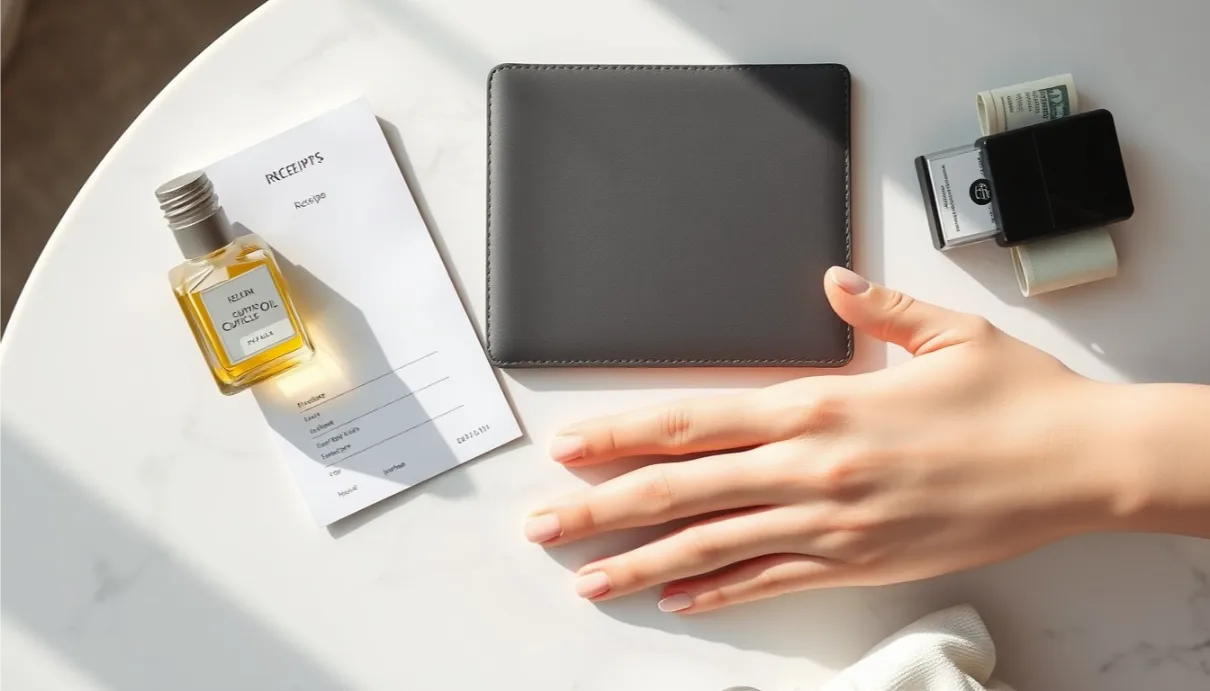
Reaching the front desk with wet polish and trying to figure out a fair tip on the spot can turn a relaxing appointment into an awkward math test.
Whether you booked a quick polish change or a two-hour gel extension set, knowing how to calculate gratuity ahead of time removes the guesswork.
A nail salon tip calculator is a simple tool or formula that determines your gratuity by multiplying your pre-tax service total by a chosen percentage—typically 15% to 20%—and splitting it accurately if more than one nail technician worked on your nails.
Nail Salon Tip Calculator
Calculate your tip, split the bill, and know exactly what to pay.
Quick Answer
To calculate a nail salon tip, multiply your pre-tax service total by 0.15 for standard service, 0.20 for great service, or 0.25 for intricate nail art or long appointments. For example, a $50 manicure calls for a $7.50 to $10 tip. Always calculate on the original pre-tax price, and tip each nail technician separately when sharing services.
What Is a Nail Salon Tip Calculator and How Does It Work?
A nail salon tip calculator uses three core inputs—your pre-tax service subtotal, your desired tip percentage, and the number of nail technicians who assisted you—to produce an exact dollar amount in seconds.
While online tools and phone apps do the arithmetic automatically, understanding the underlying formula lets you calculate tips effortlessly even when your hands are under a drying fan.
Here is the basic formula:
If you do not want to reach for your phone with wet nails, use the 10% Anchor Method—a reliable mental math shortcut that works for any salon bill:
- Find 10% first: Move the decimal point one place to the left. On a $60 service, 10% is $6.00.
- Double it for 20%: Multiply your 10% figure by two. Double $6.00 to get $12.00.
- Add half of 10% for 15%: Take your 10% figure ($6.00) and add half of it ($3.00) to get $9.00.
- Add another half of 10% to your 20% figure for 25%: Take $12.00 plus $3.00 to get $15.00.
- Round to a clean dollar amount: If you are paying in cash, rounding up to the nearest whole dollar keeps checkout simple and saves you from hunting for loose coins.
Because salon receipts sometimes bundle services with retail items—like cuticle oil or hand lotion—remember to subtract retail products before running your calculation.
Gratuity applies to hands-on labor, not packaged merchandise pulled from a display shelf.
How Much Should You Tip at a Nail Salon?
In the United States and Canada, standard etiquette is to tip 15% to 20% of your pre-tax service total for satisfactory nail care, rising to 20% to 25% for detailed work or exceptional service [VERIFY: regional norms]. The exact percentage you choose depends on the complexity of the appointment, the time required, and the care your nail technician puts into prep and cleanliness.
Use these general benchmarks to pick a fair rate:
- 15% (Baseline / Satisfactory): Appropriate for straightforward, quick services—such as a classic polish manicure or basic pedicure—where the result is neat and meets expectations.
- 18% to 20% (Standard / Great Service): The most common range for regular appointments, especially when your nail technician takes extra care with cuticle prep, nail shaping, color consistency, and comfort.
- 20% to 25%+ (Detailed, Complex, or Exceptional): Ideal for custom hand-painted nail art, chrome or cat-eye finishes, intricate 3D charms, structured builder gel, full acrylic sets, heavy callus removal, or appointments where your technician squeezed you in as a last-minute booking or stayed late to finish your set.
If you book a very inexpensive mini-service—such as a $10 polish change or a $5 single-nail fix—a straight percentage can feel disproportionately small for the technician’s chair time and sanitation setup. In those cases, leaving a flat $3 to $5 minimum tip is a courteous alternative to calculating 15%.
Nail Salon Tip Chart: Quick Reference Table
When you want an instant number without doing mental math, match your pre-tax service subtotal to the nearest row in this reference table. All figures are based on illustrative service totals to help you estimate quickly at checkout.
| Pre-Tax Service Total | 15% Tip | 18% Tip | 20% Tip | 25% Tip |
| $15 | $2.25 (consider $3–$5 flat) | $2.70 | $3.00 | $3.75 |
| $25 | $3.75 | $4.50 | $5.00 | $6.25 |
| $35 | $5.25 | $6.30 | $7.00 | $8.75 |
| $45 | $6.75 | $8.10 | $9.00 | $11.25 |
| $50 | $7.50 | $9.00 | $10.00 | $12.50 |
| $65 | $9.75 | $11.70 | $13.00 | $16.25 |
| $75 | $11.25 | $13.50 | $15.00 | $18.75 |
| $85 | $12.75 | $15.30 | $17.00 | $21.25 |
| $100 | $15.00 | $18.00 | $20.00 | $25.00 |
| $120 | $18.00 | $21.60 | $24.00 | $30.00 |
| $150 | $22.50 | $27.00 | $30.00 | $37.50 |
Quick tip for odd totals: If your bill falls between two rows—say, $58—mentally round up to $60 to pick your tip ($9 at 15%, $12 at 20%). It takes two seconds and avoids juggling change with freshly painted nails.
How to Calculate Tips for Common Nail Salon Scenarios
Real salon visits rarely look like a single neat line item on a receipt. Taxes, shared technicians, gift cards, and small repairs all affect how you should apply a nail salon tip calculator so every person who worked on your hands or feet is compensated fairly.
Should You Tip on Pre-Tax or Post-Tax Totals?
Standard etiquette is to calculate your tip on the pre-tax service subtotal, not the final amount after sales tax is added.
Sales tax varies widely by state, province, and municipality—and in some locations, personal care services are not taxed at all [VERIFY: local tax regulations].
Basing your tip on the pre-tax price keeps your calculation consistent and ensures you are tipping for the service itself rather than government taxes.
That said, many digital point-of-sale tablets automatically calculate suggested tip buttons (18%, 20%, 25%) using the post-tax total. If you prefer tipping on the pre-tax subtotal, simply tap “Custom Tip” and enter your own dollar figure.
How to Split a Tip Between Multiple Nail Technicians
When more than one nail technician works on you during the same visit—for instance, one technician handles your manicure while another performs your pedicure—calculate each person’s tip based on the individual price of the service they performed rather than splitting one total evenly down the middle.
Here is an example of why proportional splitting matters:
- Suppose your classic manicure costs $30 (Technician A) and your spa gel pedicure costs $60 (Technician B), bringing your pre-tax total to $90.
- At 20%, your total gratuity is $18.
- Splitting proportionally gives $6 to Technician A (20% of $30) and $12 to Technician B (20% of $60).
If two technicians split a single service—for example, one removes old acrylics while another applies the new set and nail art—ask the front desk how the salon divides tips, or hand each technician a separate tip envelope or cash amount proportional to the time they spent with you.
How to Tip on Discounted Services, Coupons, and Gift Cards
Always calculate your tip using the full, pre-discount menu price of your service, even if you pay with a promotional voucher, loyalty reward, seasonal discount, or gift card.
Your nail technician performs the exact same labor, preparation, and cleanup regardless of how you paid for the appointment.
For example, if a $70 gel manicure is discounted to $50 with a salon coupon, calculate your 20% tip on $70 ($14) rather than $50 ($10). Similarly, if you receive a $50 gift card as a present, check whether the card balance covers tips (some salons allow gift cards to cover gratuity, while others require cash or a separate card for tips) and plan to tip on the full service value.
Should You Tip for Nail Repairs, Soak-Offs, or Polish Changes?
Yes—even brief standalone services deserve a tip unless the repair is fixing a mistake made by the salon a day or two earlier.
Nail technicians still sanitize tools, prep the station, and block out chair time for soak-offs, single-nail acrylic patches, and quick polish swaps.
Because 20% of a $10 or $15 service is only $2 to $3, many salon regulars opt for a $3 to $5 flat tip for quick add-ons or removals. If you return within a salon’s stated guarantee window because a gel nail lifted prematurely due to an application error, tipping is optional—though leaving a few dollars is still a kind gesture if a different technician takes time out of their schedule to fix it for you.
Do You Tip the Nail Salon Owner or an Independent Nail Technician?
Modern etiquette generally welcomes tipping both salon owners and independent nail technicians (such as booth renters or private suite artists), though the old rule was that you did not have to tip a business owner. Today, many nail studio owners work behind the chair full time alongside their staff, and solo studio owners set their own prices while covering rent, supplies, sanitation equipment, and insurance.
- If the technician is a solo studio owner or booth renter: Check their booking confirmation or studio signage first. Some independent nail artists explicitly state “gratuity-free” or “tipping not expected” because they build their desired hourly rate directly into their menu prices. If they do not advertise a gratuity-free policy, tipping 15% to 20% is customary and appreciated.
- If the owner of a multi-chair salon does your nails: Tipping is optional under traditional etiquette, but most owners who actively perform services graciously accept tips—or will politely decline if they prefer not to take them.
Cash vs. Card vs. Digital Apps: What Is the Best Way to Tip?
Cash is the most universally appreciated way to tip at a nail salon because your nail technician receives 100% of the amount immediately with no card processing deductions.
However, credit cards and peer-to-peer payment apps are widely used too, and each method comes with practical trade-offs.
| Tipping Method | Pros | Cons | Best For |
| Cash | Goes directly to the technician immediately; no credit card processing fees deducted; easy to divide among multiple technicians. | Requires stopping at an ATM beforehand; awkward to pull from a wallet if your polish is still wet. | Everyday salon visits, multi-technician appointments, and salons with “cash tips only” policies. |
| Credit / Debit Card | Convenient when you do not carry cash; simple single-receipt checkout. | Some salons deduct card processing fees from tips or hold payouts until payroll [VERIFY: varies by state/local labor law]; harder to verify splits between two technicians. | Salons that explicitly allow card tipping and track technician assignments in their POS system. |
| Digital Apps (Venmo, Zelle, Cash App) | Fast, paperless, and goes straight to the individual technician’s account; no handling cash with wet nails. | Not all technicians or salons permit personal app transfers; requires scanning a QR code or confirming a username. | Independent nail artists, private suites, and salons displaying individual technician QR codes at stations. |
Practical tip for wet nails: If you plan to tip in cash—especially for a traditional air-dry manicure—pull your payment and tip out of your wallet before your technician applies base coat, or pay right before polish goes on. Many salons encourage paying prior to polishing specifically so you do not dent a fresh manicure while digging for bills.
How to Handle Tipping When You Are Unhappy With Your Nails
If something about your manicure or pedicure looks off, the best first step is to speak up politely before you leave the chair rather than quietly walking out frustrated and leaving zero tip.
Most nail technicians genuinely want you to love your nails and can fix an uneven shape, missed edge, or smudged coat in minutes if you mention it calmly.
Knowing how to adjust your tip depends on what went wrong:
- Minor preferences or fixable flaws: If a nail shape is slightly crooked or a color looks streaky, kindly point it out while you are still seated. When the technician corrects it professionally and warmly, tip normally (15% to 20%).
- Unresolved quality issues or rushed, careless work: If you politely ask for a fix and are dismissed, or the finish is noticeably sloppy despite your feedback, lowering your tip to 10% (or speaking calmly with the salon manager about a redo) is reasonable.
- Rude treatment, unsafe hygiene, or physical injury: You are never obligated to tip if a technician is openly hostile, uses visibly unsanitized tools, ignores your request to stop when something hurts, or causes a cut or burn. Pay for the service as required—or ask to speak with management—and do not return.
A note on nail health and safety: While minor nicks or tenderness can happen occasionally during aggressive cuticle work, nail salon services should never cause persistent pain, swelling, redness, pus, or lasting nail discoloration.
If you notice signs of a skin or nail infection, an allergic reaction to gel or acrylic products, or unusual nail changes after an appointment, do not try to treat it with home remedies—consult a licensed doctor or board-certified dermatologist promptly (as recommended by dermatology associations such as the American Academy of Dermatology [VERIFY]).
Common Nail Salon Tipping Myths vs. Facts
Confusion around tipping often stems from outdated advice or assumptions borrowed from restaurant etiquette. Clearing up these common myths helps you tip with confidence.
- Myth: You should never tip a nail salon owner.Fact: While traditional etiquette once exempted business owners from tips, modern salon norms have shifted. Many salon owners and solo nail artists perform services full time and gladly accept tips unless they clearly state their business is gratuity-free.
- Myth: Leaving one lump sum on your credit card guarantees an equal split.Fact: Front desk systems do not always automatically divide a single card tip between multiple technicians. Always specify verbally—or on the receipt—how much goes to each technician by name or service.
- Myth: A “service fee” or “supply surcharge” on the receipt is the technician’s tip.Fact: Processing fees, sanitation surcharges, or supply fees go to the salon’s operating expenses, not directly to your nail technician’s pocket. Only an explicitly labeled “gratuity” or “tip” counts as a tip.
- Myth: You do not need to tip if you use a prepaid gift card.Fact: Gift cards are simply a form of payment, just like cash or a debit card. Unless the giver explicitly added gratuity onto the gift card balance—and the salon confirms it—you should still calculate and leave a tip based on the full pre-tax service price.
Who This Guide Applies To (and Regional Considerations)
The percentage guidelines and nail salon tip calculator formulas in this guide apply primarily to nail salons in the United States and Canada, where tipping is a standard part of personal-care service culture and often makes up a meaningful portion of a nail technician’s take-home income [VERIFY: regional wage structures].
If you are traveling or living outside North America, tipping expectations change significantly:
- United Kingdom & much of Europe: Tipping at nail salons is generally discretionary rather than expected. Leaving 5% to 10% or rounding up to the nearest £5 or €5 is appreciated for great work, but skipping a tip is not considered rude [VERIFY].
- Australia & New Zealand: Service wages are typically built directly into menu pricing, and tipping at nail salons is uncommon [VERIFY].
- Japan & parts of East Asia: Tipping is generally not practiced and can occasionally cause confusion or polite refusal [VERIFY].
Whenever you visit a salon in a new country—or a gratuity-free studio in your own city—checking the booking page or asking the receptionist discreetly is always the easiest way to respect local norms.
Frequently Asked Questions About Nail Salon Tipping
How much do you tip for a $50 manicure or pedicure?
For a $50 pre-tax nail service, a standard 15% tip is $7.50, while a 20% tip is $10.00. If your appointment included detailed nail art, gel removal, or extra massage time, tipping 25% ($12.50) is a generous way to recognize the extra work.
Should you tip before or after getting your nails painted?
You can pay and tip either before or after your service, depending on salon preference. For traditional air-dry polish, many clients prefer settling the bill and handing over a cash tip before polish is applied so they do not smudge wet nails while reaching into their wallet.
What if I forget to bring cash to the nail salon?
If you forget cash, ask the receptionist before your appointment starts whether tips can be added to a credit card or sent via Venmo, Zelle, or Cash App. Most modern salons accept card tips, though some smaller shops operate cash-only for gratuities and may have an ATM nearby.
How much should you tip for a gel manicure and pedicure combo?
Calculate 15% to 20% of the combined pre-tax total—or 20% to 25% if your set involves intricate nail art or long soak-off removal. If one nail technician does your manicure and another does your pedicure, divide the tip proportionally based on each service’s individual menu price.
Is 15% considered a low tip at a nail salon?
No, 15% is still considered an acceptable baseline tip for straightforward, satisfactory nail services like a basic polish manicure. However, 18% to 20% has become the most common standard for gel manicures, acrylics, pedicures, and attentive, detail-oriented service.
Final Thoughts on Using a Nail Salon Tip Calculator
Walking into a nail appointment with a clear plan for gratuity lets you relax in the chair instead of stressing at the register.
Whether you rely on a quick nail salon tip calculator, keep the 10% mental math shortcut in your back pocket, or bookmark the reference chart above, tipping comes down to fairness, clarity, and appreciation for skilled hands-on work.
- Calculate on the pre-tax, pre-discount price—typically 15% to 20% for standard services and 20% to 25% for complex nail art or extensions.
- Split tips proportionally when multiple nail technicians assist you, based on the cost of each person’s service.
- Prepare payment early (especially cash) if you are getting regular polish, so fresh nails stay smudge-free.
- Communicate politely in the chair if something needs adjusting, and prioritize sanitation and comfort every visit.
If you are planning your next salon visit, you might also find it helpful to brush up on how to communicate your preferred nail shape and length to your technician—or review a basic checklist of salon hygiene standards to look for before sitting down.